
The Only Tulip Guide You Need in the Netherlands
Updated: Feb 6
A practical, honest guide to tulip season, tulip fields, and tulip photoshoots

As spring arrives, the cold and gloom in the Netherlands begin to fade. Days grow longer, color returns to the countryside, and beyond the canals of Amsterdam, tulip fields appear for a brief moment each year.
Tulip season in the Netherlands is short and weather-dependent, but when timed right, it’s unforgettable.
If you’re visiting in spring, especially to see the tulip fields or plan a tulip photoshoot, knowing when and where tulips bloom matters. Miss the timing or go to the wrong place, and the experience can easily feel underwhelming.
This guide breaks down when tulips bloom in the Netherlands, where to find them, how to get there, and how to experience tulip season properly. This guide is based on real conditions, real experience, not ideal scenarios.
1. The Truth About Tulip Season in the Netherlands
Tulips are often the first thing people associate with the Netherlands, and indeed tulips have played a significant role in Dutch history, agriculture, and international trade for more than four centuries, shaping both the country’s cultural identity and its global image. Tulips are often treated as a permanent symbol of the Netherlands. In reality, they are anything but permanent.
A Brief History of Tulips in the Netherlands

Tulips did not originate in the Netherlands. They are native to Central Asia, spanning regions from the Iranian plateau to the Tian Shan mountains. Long before tulips became associated with Dutch landscapes, they held cultural significance in Anatolia under Seljuk and later Ottoman rule, where the flower symbolized wealth, refinement, and power.
Through diplomatic exchanges and trade routes with Constantinople (modern-day Istanbul), tulip bulbs reached Western Europe in the late 16th century. At the time, tulips were rare, exotic plants, unlike anything growing naturally in Northern Europe.
In the Netherlands, early tulip cultivation was driven by botanists and collectors rather than farmers. The most influential figure was Carolus Clusius, one of the most important botanists of his time. In 1593, Clusius moved to Leiden to become the first prefect (director) of the Hortus Botanicus Leiden, the oldest botanical garden in the Netherlands. The garden was established primarily for medical and botanical research, but it would unexpectedly become the birthplace of Dutch tulip cultivation.
Clusius planted and studied tulips systematically, documenting their behavior, variations, and ability to adapt to the Dutch climate. His work laid the scientific foundation for tulip cultivation in the Netherlands. In fact, the Clusius Garden still exists today in Leiden, offering a glimpse into how the botanical garden may have looked over 400 years ago.
By the early 17th century, tulips had moved beyond botanical curiosity and entered the world of commerce. This culminated in the 1630s with Tulip Mania, now recognized as one of the earliest recorded speculative bubbles in economic history. At its peak, rare tulip bulbs reportedly sold for prices equivalent to several times an average annual salary. While the market collapsed abruptly in 1637, the episode left a lasting imprint on Dutch cultural memory and economic thought.
What’s often overlooked is that Tulip Mania did not end tulip cultivation—it accelerated it. In the centuries that followed, advances in horticulture, breeding, and trade transformed tulips from rare luxury items into a scalable agricultural product. By the 19th and 20th centuries, the Netherlands had refined bulb production to an industrial level, exporting tulips across Europe and eventually worldwide.
Tulips Today: A Global Industry, Not a Tourist Attraction

Today, tulips are not grown primarily for visitors, the Netherlands is the world’s largest producer and exporter of tulip bulbs, supplying the majority of the global market.
The Netherlands supplies the majority of the world’s commercial flower bulbs, exporting billions annually to Europe, North America, and Asia.
Tulip fields exist for agriculture first—tourism is secondary.
This long history, from botanical experiment to speculative obsession to modern agriculture, explains why tulips occupy such a unique place in Dutch culture. They are not only a symbol; they are the result of centuries of science, trade, and adaptation.
This matters because it explains one essential truth: Tulip fields are working landscapes, not open-air museums.
Why Tulip Season Is So Short
Tulip flowers bloom for roughly 2 to 4 weeks.
Early varieties bloom in early April
Late varieties peak toward late April
Most production fields are cut by early May
Once a bloom matures, growers remove the flower so the bulb can store energy for the following year. A field that looks perfect today may be gone tomorrow.
This is normal and unavoidable.
When Do Tulips Bloom in the Netherlands?
There is no fixed tulip date. Bloom timing depends on:
Winter temperatures
Early spring weather
Sun exposure and rainfall
In warm years, peak bloom can arrive by mid-April. In colder years, it may extend into early May. A single warm week can accelerate blooming dramatically.
The most reliable travel window:
Mid-April to late April
If your dates are fixed, don’t worry, tulips can still be seen:
Keukenhof has indoor and sheltered displays (In 2026, Keukenhof will be open from March 19th to May 10th.)
National Tulip Day (third Saturday of January) features a temporary tulip garden in Amsterdam with ~200,000 tulips
2. Where to See Tulips in the Netherlands
Fun fact: Tulips do not grow everywhere.
You will not step out of Amsterdam Central Station into endless fields. Tulips appear in specific regions, and knowing where to go makes all the difference.
Amsterdam (City Tulips)
When springe tulip for every truly arrives, Amsterdam does offer a city-level introduction to tulip season through the Amsterdam Tulip Festival, which in 2026 runs from 19 March to 10 May. During this period, tulips appear across parks, streets, and public spaces, adding bright color to the urban landscape.
The festival’s long-term goal is to place on Amsterdammer, amounting to around 800,000 tulips planted throughout the city. Visitors can experience the festival simply by walking around and spotting tulips in everyday locations. Regular participating sites including
Rijksmuseum
Vondelpark
Rembrandtplein
EYE Filmmuseum
This is an easy, low-effort way to experience tulips while staying in the city. However, it’s important to be clear: this is not the same as visiting tulip fields. For the full tulip experience such as vast fields, uninterrupted color, and the landscapes people usually imagine, you will need to travel outside Amsterdam to the main tulip-growing regions.
Bollenstreek (The Flower Strip)

The Bollenstreek, also known as the Flower Strip, is located behind the North Sea dunes between Amsterdam, Haarlem, Leiden, and The Hague. This is the region most people picture when they think of Dutch tulips, and for good reason.
During tulip season, the Bollenstreek is filled with vast flower fields of tulips, daffodils, and hyacinths, set against classic Dutch countryside scenery. Flat land, long roads, farmhouses, and strong horizon lines make this area visually striking, especially when combined with the colorful fields.
The region is home to the famous Keukenhof Gardens, as well as several visitor-friendly tulip farms such as De Tulperij, The Tulip Barn, and Tulip Experience Amsterdam. Each offers a slightly different experience.
Keukenhof is best known for its enormous variety of tulips and highly curated garden layouts; it's more of a garden experience than an open-field one.
The farms, on the other hand, provide a more immersive field setting, often with cafés, playgrounds, and photography props.
Keukenhof is the easiest location to reach from Amsterdam thanks to direct bus connections during tulip season (details can be found on the Keukenhof website and Amsterdam Tulip Festival website).
The farms are slightly harder to access, but still very manageable. Over the past three years, I’ve visited all of them using public transport combined with walking, and occasionally by renting a bicycle, which is actually one of the nicest ways to experience the region. Cycling allows you to move between farms at your own pace and really take in the landscape.
For first-time visitors, the Bollenstreek is an excellent introduction to tulip season. Some areas even allow walking paths alongside designated photo zones near the fields.
And yes—there is also the famous Dutch Flower Parade (Bloemencorso Bollenstreek)!!!
In 2026, the Flower Parade will take place on Saturday, 18 April, marking its 79th edition. On the Friday evening before, there is even an illuminated Flower Parade by Night in Noordwijkerhout. From 17 April, 8:00 pm to 11:00 pm, the decorated floats can be admired up close before they move through the village streets in the evening.
It’s colorful, festive, and uniquely Dutch, but also very busy. During peak bloom and parade days, expect crowds and a lively, almost carnival-like atmosphere.
Flevoland (Largest Tulip-Growing Region)

Despite the fame of the Bollenstreek, it does not contain the largest tulip fields in the Netherlands. That title belongs to Flevoland.
Flevoland is a truly unique part of the country. It’s the youngest Dutch province, officially established in 1986, and one of the largest human-made land reclamation projects in the world. Created from the former Zuiderzee during the 1950s and 1960s, Flevoland stands as a striking example of Dutch engineering and water management.
What this created, quite unintentionally, is space—vast, open land that is ideal for large-scale agriculture. Over time, Flevoland became the largest continuous tulip-growing region in the world, with more than 4,000 hectares of tulips planted annually alongside crops like potatoes, onions, and grains.
For the past two decades, Flevoland has also hosted the Noordoostpolder Tulip Festival, which in 2026 runs from 17 April to 3 May.
During the festival, designated cycling, walking, and driving routes guide visitors through blooming fields. There are also additional activities such as museums, farm visits, local restaurants, and family-friendly events. They even have helicopter rides, hot air balloons, and special themed experiences.
Compared to the Bollenstreek, Flevoland feels far less touristic. The fields are larger, the skies feel wider, and the experience is slower but wilder. It’s ideal if you want to truly step away from crowds and spend time moving through the landscape.
The downside is accessibility. There is no direct public transport from Amsterdam to the fields themselves, so reaching Flevoland takes more effort.
But that effort is exactly what keeps it peaceful. If you’re willing to plan ahead, Flevoland offers one of the most immersive tulip experiences in the Netherlands.
North Holland (Alkmaar & Schagen)
Often overlooked in favor of Keukenhof or Flevoland, the tulip fields around Alkmaar and Schagen quietly hold their own place in the Dutch tulip landscape.
North of Alkmaar begins the Kop van Noord-Holland, one of the country’s key bulb-growing regions. Here, tulips don’t appear as a single attraction but as a patchwork of working agricultural fields, placed side by side across open countryside. When the tulips bloom, usually from mid-April onwards, depending on the weather, the effect can be surprisingly powerful.
What makes this region special is its authenticity. These fields are grown for bulbs, not visitors. There are no ticket booths, no curated viewpoints, and no guarantees. Bloom periods can be short, and once the flowers have served their purpose, they are cut. That unpredictability is part of the experience.
To me, the tulips here feel less like a spectacle and more like part of the land, something that appears, peaks, and disappears as part of a natural rhythm. If Keukenhof is about seeing tulips perfectly framed, North Holland is about seeing how tulips actually exist in the Dutch landscape.
The trade-off is access. You’ll need a bike or a car to fully experience the region. Public transport gets you to Alkmaar easily, but from there, effort is required. Still, that effort filters out crowds, and what you get in return is a quieter, more grounded tulip experience.
3. Keukenhof vs Tulip Fields vs Tulip Farms
Keukenhof Gardens

A curated tulip park with guaranteed flowers.
Best for: First-time visitors who want certainty
Not ideal for: Natural or quiet photoshoots, expecting large continuous tulip field
Tulip Fields
Real agricultural fields used for bulb production.
Best for: Authentic landscapes and large-scale visuals
Important: Access is limited and fields must be respected
Tulip Farms

Visitor-friendly farms designed for walking and photography (such as De Tulperij, The Tulip Barn, Tulip Experience Amsterdam).
Best for: Easier access with fewer crowds than Keukenhof Choosing the right option depends on whether you prioritize convenience, authenticity, or photography.
4. Tulip Photography & Photoshoots


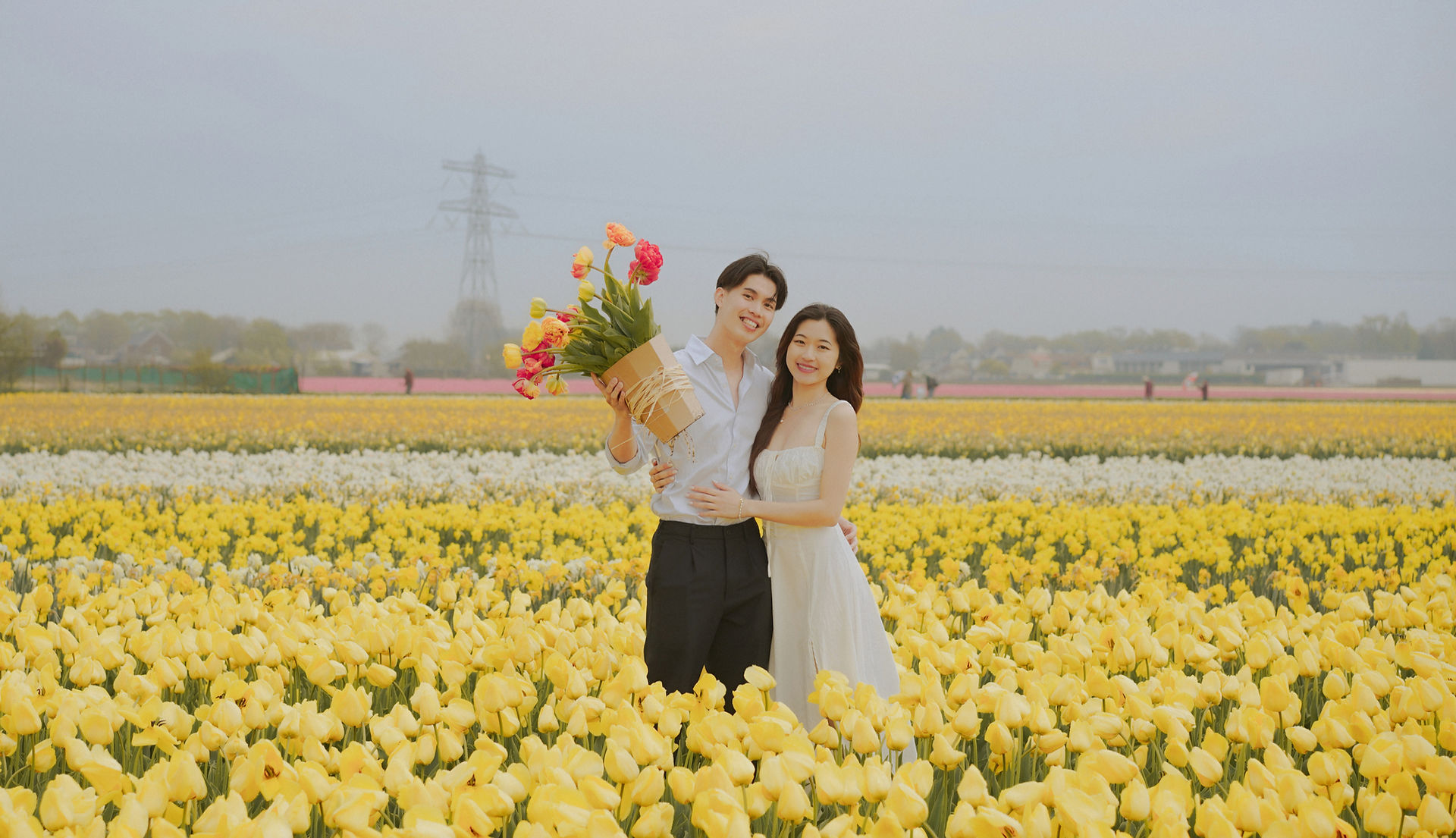


Honestly, it’s quite hard to completely mess up tulip photos. Tulip fields are naturally beautiful, the colors are strong, and even simple compositions already look great. That said, when it comes to portraits in tulip fields, a bit of planning makes a huge difference.
For the past three consecutive tulip seasons, we’ve been working in and around tulip locations across the Netherlands, photographing couples, proposals, weddings, families, maternity shoots, and solo travelers. Every season teaches us something new, mostly because tulip season never behaves exactly the same way twice.
This year, we offer two tulip photoshoot packages:
Both options can take place either at Keukenhof Gardens or at tulip farms in the Bollenstreek area. The difference between the packages mainly comes down to shooting time, group size, and the number of final images delivered.
These are meant to be easy, worry-free sessions. If you simply want beautiful tulip photos, for yourself, with your partner, with family, or as a gift, this is designed so you don’t need to overthink anything. You book the session, we guide you on timing, location, and what works best, and you just show up and enjoy the moment. No pressure, no complicated planning.
If you already have more experience with tulip fields, or you’re looking for something more specific, for example:
shooting at a private farm
photographing tulips in Flevoland
combining Keukenhof with open fields
or planning a more editorial or personal concept
You’re very welcome to reach out. You can send us a message via email or through the 21’s Lightspot website, let us know what you have in mind, and we’ll come back to you with a tailored proposal and quote.
You can find our current tulip photoshoot offerings here: 2026 Tulip Photoshoot
And finally, a small reminder: almost everyone today carries a smartphone with a very capable camera. In the next blog post, I’ll share practical tips on how to take better tulip photos yourself, whether you’re visiting a field, a farm, or just spotting tulips around the city.
Tulip season is short. You might as well enjoy documenting it, one way or another.
5. Tulip Field Etiquette (This Matters!)
Tulip fields survive because visitors respect them.
Do not walk into fields
Do not pick flowers
Respect fences and signage
Each color block represents a single tulip variety grown for specific agricultural purposes. Walking into fields damages bulbs underground, even if flowers look untouched.
The best views come from roads, paths, and distance.
Final Thought
Tulip season is brief by design. That’s what makes it special.
If you treat tulip fields as scenery instead of attractions, and plan with flexibility, you’ll experience something far more meaningful than a photo opportunity.
Hope to see you this year among the tulips!
References & Further Reading
This guide is based on a combination of historical sources, cultural institutions, industry research, and on-the-ground experience. For readers who want to explore further, the following sources were used:
Tulip History & Origins
Hortus Botanicus Leiden – Official visitor information
Clusius Garden (Hortus Botanicus Leiden)
Hortus Botanicus Leiden (historical overview)
Origin of the word “tulip” – Amsterdam Tulip Museum
Tulip Mania & Economic History
Dutch Tulip Bulb Market Bubble – Corporate Finance Institute
Tulip Mania – BBC Culture
Tulip Mania explained – IamExpat Netherlands
Tulips Today & Global Industry
From bulb to bloom: Dutch tulip production – AIPH
Tulip Season & Bloom Timing
Dutch tulip fields in spring – FlowerTour
Tulip Regions & Festivals
Bollenstreek region map
Amsterdam Tulip Festival
Tulips & flowers in Amsterdam – I amsterdam
Dutch Flower Parade (Bloemencorso Bollenstreek)
Flevoland region overview
Tulip fields near Amsterdam – Tulip Tours Holland
Tulpenfestival Noordoostpolder
Tulip Route Flevoland
Tulip Photoshoots
Tulip photoshoot services – 21’s Lightspot


One guide to rule them all! Must share this to every friend I know!🌷