
Beyond Stroopwafels: Amsterdam’s Hidden Colonial Food Story
Discover Amsterdam’s unique food scene, shaped by trade routes, contract labor, and migration across continents.
A special thank you to my friend Darin Biserta for proofreading and giving valuable suggestions!
When most international visitors think of Dutch food, they picture stroopwafels, cheese, and maybe stamppot — mashed potatoes with vegetables on a cold winter evening.
But to really understand modern Amsterdam beyond the trendy cafés and canal photos, you need to understand one thing: how the Netherlands’ colonial past shapes its everyday food culture.
Whenever friends visit me here, I take them to an Indonesian or Surinamese restaurant. Because nowhere else will you find such a dense, deeply integrated presence of these two cuisines, outside of Indonesia or Suriname themselves.
These restaurants aren’t hidden away from tourists. You’ll find them in almost every neighbourhood. Look closely, and you’ll see the locals lining up at takeaway counters after work for delicious, comforting meals.
When I first moved here, though, something puzzled me.
Why were so many Surinamese restaurants combined with Javanese, Chinese, or Indian cuisine? How did these flavors from continents thousands of miles apart become intertwined?
The answer lies in colonial history.

Maintaining Culture in Adversity
Surinamese culture is inseparable from Dutch heritage due to the colonial relationship between the two countries. Today, the Surinamese community in the Netherlands continues to shape Dutch society, especially through food.
After gaining independence from Spain in the late 16th century, the Dutch built a vast colonial empire. They established plantation colonies in South America, including Suriname. Between the late 16th and 19th centuries, trading over 550,000 to 600,000 enslaved Africans to work on plantations.
Although slavery was officially abolished in 1863, emancipation came with a crucial condition: former slaves were required to continue working on plantations for 10 additional years under a system known as staatstoezicht ('state supervision'). Because of this period, many people in the Netherlands mark the true end of slavery as 1873, rather than 1863.
But plantation owners faced a new question: who would work now?
To maintain the sugar economy, the Dutch recruited indentured laborers from British India. These workers were promised good working conditions, but instead faced the same harsh treatment similar to slavery.
Plantation owners were allowed to impose penal sanctions, meaning workers could face criminal charges if deemed “lazy.” In fact, a significant number of indentured workers died due to overwork and poor living conditions.
Afterwards, the Dutch also contracted laborers from the Dutch East Indies (present-day Indonesia), particularly from Java. Between 1873 and 1939, approximately 34,000 Indians, 33,000 Javanese, and 3,000 Chinese contract laborers were brought to Suriname.
This migration makes Suriname one of the most diverse countries in the world. Today, its population of just over 600,000 includes Creole, Maroon, Hindustani, Javanese, Indigenous, Chinese, and European communities. Each group brought its own culinary traditions. That’s why rice and roti can coexist at a Surinamese dinner table.
Food became a way to preserve cultural identity amid displacement.
From Paramaribo to Amsterdam
When Suriname became independent in 1975, many people migrated to the Netherlands. Today, around 400,000 people of Surinamese descent live in the Netherlands. Considering the population in Suriname, this is a large group, isn’t it?
Surinamese-Javanese and Surinamese-Hindustani immigrants opened the first Surinamese restaurants, introducing bold flavors and new ingredients to the dining plates.

Where to Taste Surinamese Food in Amsterdam
From small neighborhood snack bars to lively restaurants, here’re some places to experience it yourself:
Famous for broodje pom, a sandwich filled with a spicy, citrusy chicken and pomtajer (a root vegetable) mixture. You’ll find branches in Amsterdam that’re probably under your visit list: Waterlooplein, Zeedijk, and Haarlemmerstraat.

A beloved supermarket in De Pjip for Mexican and Asian ingredients. At lunchtime, they also serve excellent Surinamese sandwiches.

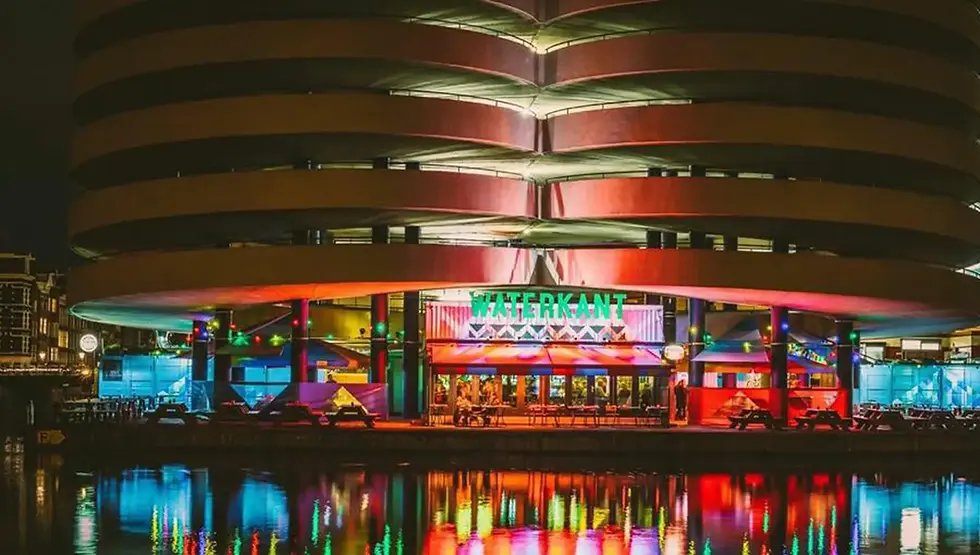
As the name suggests ('waterfront'), this restaurant has a large terrace along the Singelgracht. When the sun is out, grab a Surinamese beer, watch the boats go by, and soak in the atmosphere.
Even in the colder months, this place offers tropical warmth. Whether you want a chill lunch with friends or a late-night party, this place has it all.
An authentic Surinamese/Caribbean restaurant tucked away near Kinkerstraat. In collaboration with Patta, the Amsterdam streetwear brand founded by Surinamese-Dutch creatives, Meo’s has become a celebration of culture and community.

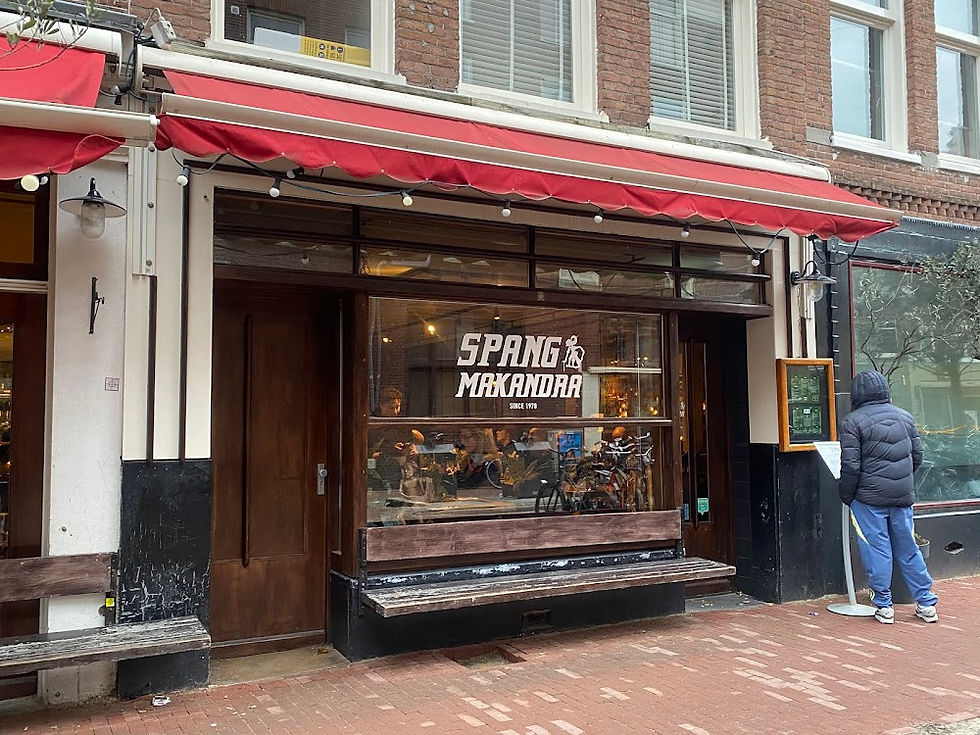
Opened in 1978 and now with two locations in De Pijp and West, this is my go-to place when friends visit. The menu offers plenty of Surinamese-Javanese dishes, and we’re always welcomed with warm hospitality.
What to Try
Since Surinamese food can be found in almost every neighborhood, don’t forget to explore near where you’re staying. We recommend these dishes to try if you’re new to Surinamese cuisine:
Cassava with salted cod
Baka bana (fried plantain with peanut sauce)
Bara (fried dough with curry filling, originally from India)
Try it with some sort of pepper, e.g., chutney, for the real experience
Petjel/Petjil (vegetables with peanut sauce)
Saoto soup (Javanese-Surinamese chicken soup)
Pom (a baked pomtajer and chicken casserole, often served in a sandwich)
Bakkeljauw (salted cod)

For History and Cultural Enthusiasts
If you’re passionate about history and culture, we recommend adding these places to your itinerary. Both are located in Amsterdam East, and not far from each other.
Suriname Museum offers a comprehensive overview of Suriname’s history through photographs, personal stories, and historical artifacts. This place will give you in-depth knowledge of the indigenous cultures, colonial history, and contemporary developments in Suriname.

Formerly known as the Tropenmuseum, the Wereldmuseum explores global cultures by connecting the past and present. The museum has a colonial history section, but also explores important modern topics that concern us all, such as global trade, migration, climate change, etc.

As you explore Amsterdam beyond its postcard clichés, you’ll start to notice that the city reveals itself in layers: in the stories behind its food, in the communities that shape its streets, and in the people that made up the city.
These are the experiences that make a trip truly personal and unique. And while flavors may fade, the feeling of being in Amsterdam doesn’t have to. If you’d like to preserve your own Amsterdam story, whether it’s wandering through local neighborhoods, sharing a meal, or simply soaking in the atmosphere.
We offer photography experiences designed to capture those moments in a natural and meaningful way. You can explore our photoshoot options through our website and turn your memories in Amsterdam into something lasting.
Enjoy exploring — and eating. And don’t forget to say 'Spang!' (Dutch slang for tasty or great) to the restaurant staff.
Reference:


Comments